

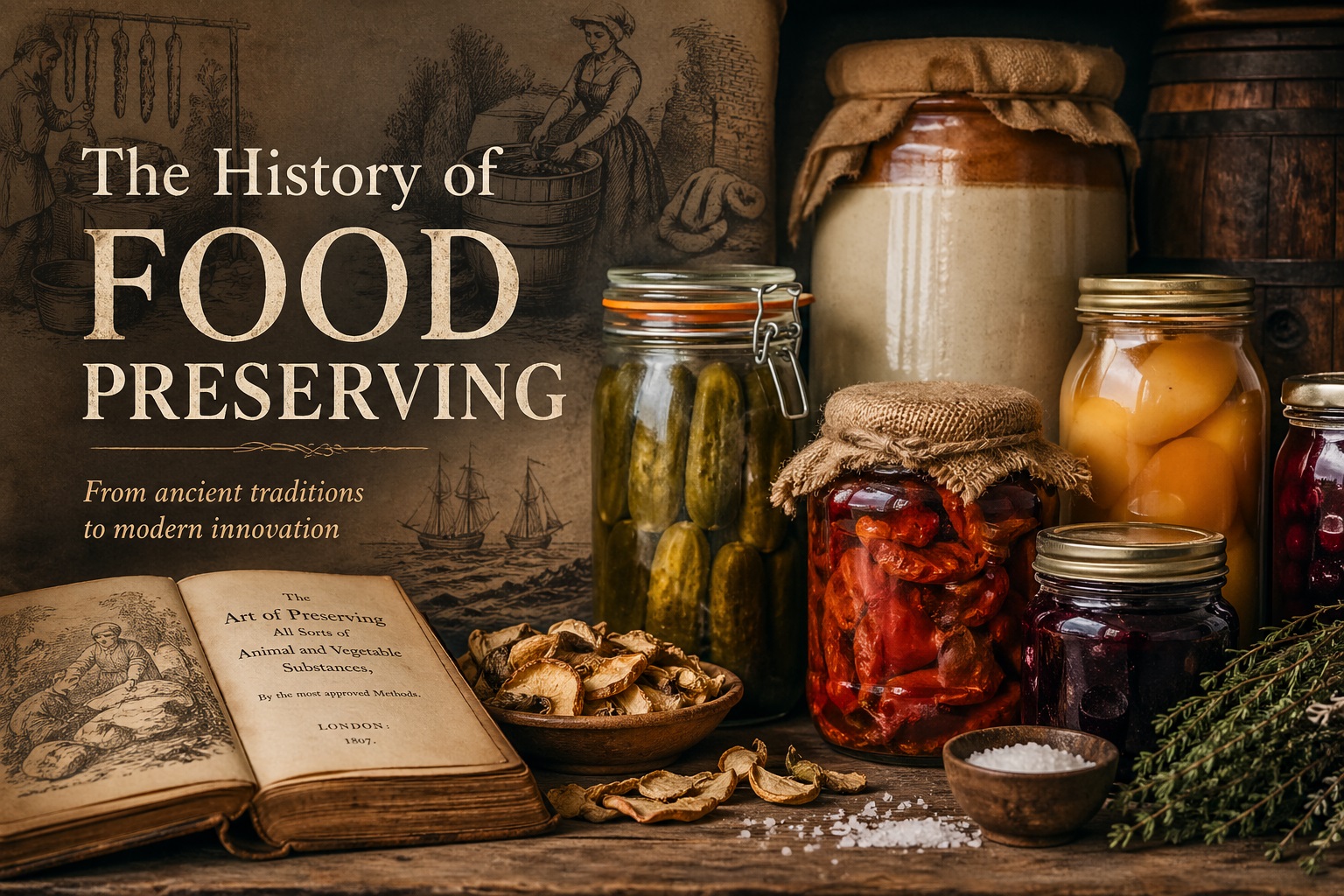
Today you can walk into any supermarket or delicatessen and be faced with a profusion of foods preserved in exciting and exotic ways. Even with the advent of modern preserving methods such as freezing and canning, many people still yearn for traditionally preserved goods. Ancient techniques, including pickling, smoking, and curing, add a distinctive and delicious flavor to fresh produce.
Moreover, preserves offer a comforting alternative to our usual ephemeral foods. In this age of microwave cookery and instant fast food, the art of preserving reminds us to observe the seasons and the changes that occur throughout the year. It also helps to revive our jaded senses and, especially for those of us living in an urban environment, can bring us closer to nature. In order to master this wonderful culinary art, we need to know something of its history and the evolution of the technical processes that are used today.
Why Food Spoils
Spoilage is caused by the natural deterioration of organic matter as a result of enzyme activity and the growth of yeasts, molds, and bacteria. These processes need certain conditions: a warm, moist, balanced pH environment and a supply of oxygen. Eliminate one or more of these factors and deterioration will be greatly slowed or will cease. Throughout history, people have discovered many ingenious and inventive ways to prevent spoilage: thus, the art of preserving has become of fundamental and lasting importance.
Sun, Wind, and Fire
It is safe to assume that drying was the first method of preservation to be discovered – a piece of meat left out and dried by the sun was found to have an appetizing smell, lasted longer than fresh meat, and was lighter and easier to transport. This discovery meant that there was no need to consume the meat at the site of a kill. It could be dried and transported to a safe, permanent settlement, and stored. This enabled our ancestors to begin to settle down; to organize their food supplies for the community; and to start to plan their lives. They were able to travel farther and explore more congenial environments, where food could be grown and animals reared. Slowly, the first primitive settlements gave way to more permanent hamlets and villages, laying down roots from which grew our present-day towns and cities.
Sun- and wind-drying were fine in hot, dry climates but not very practical in cold, damp environments. In areas where wood was abundant, fire and smoke were used to hasten the drying process. Smoked fish and meat were found to have a more savory smell and to last even longer, partly because the smoky coating deterred insects.
Salt of the Earth
Ancient peoples discovered the preserving qualities of salt. They found it to be a strong dehydrator, extracting
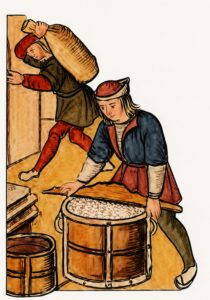
moisture from tissues, drying them and creating an environment that inhibited the growth of harmful bacteria.
For our ancestors, salt became an essential commodity, highly prized and fiercely guarded: the first biblically recorded war was fought over the rights to control salt pans (Genesis 14:10). In ancient Egypt, large quantities of salt, together with vinegar and honey, were used in the process of mummifying. Salted meat and fish played an essential role in the medieval European diet — especially during Lent when salted fish was the only available source of protein. Salt reached a price that was sometimes higher than the value of the flesh preserved – “not worth its salt” indeed! Salted meat and fish were also convenient foodstuffs to take on board ship for long voyages, allowing sixteenth-century Europeans to explore and colonize, and change the course of world history.
Sweet and Deadly
Like salt, sugar is one of nature’s most powerful poisons – in high concentrations it creates an environment that cannot support any living organism. In a historical context, sugar is a rather late arrival. It was unknown to the ancient Egyptians and Hebrews and is not mentioned in early Greek or Roman writings – their sweetener was honey from bees or fruit (concentrated nectar).
Originally, most sugar was refined from the sweet sap of the sugarcane, which is indigenous to the Indus Valley. A variety of wild grass, sugarcane was considered to be a gift from the gods and symbolized everything that was good on earth. The complicated technique of sugar refining was perfected at the courts of the emerging Arab Empire, which at one stage ruled almost all the known world. While Europe was in the depths of the “medieval winter,” the conquering Arab tribes were establishing a creative, indulgent, and luxurious way of life. Trading caravans from all corners of the ancient world brought rare and mysterious new culinary ingredients, spices and cooking techniques. In the kitchen, sugar was combined with fruit and spices and turned into fragrant syrups, halvas, marzipan, and candy.
In the twelfth century, Arab merchants and returning Crusaders brought sugar into Europe. Refined sugar soon became an essential ingredient in the laboratories of alchemists and apothecaries where it was used, literally, to sweeten bitter pills and potions. Sugar craft reached its peak in the wealthy kitchens of Renaissance Italy, where it was used to produce elaborate centerpieces made of sugar paste and lifelike candied fruit. But it was not until the sixteenth century, when sugar was introduced to Europe from the West Indies, that it became an indispensable ingredient, included in everything from candy and cakes to stews. It was later discovered that sugar plays an important role in curing meat, as it counteracts the toughening effect of salt. The Europeans’ insatiable appetite for sugar had a devastating and everlasting effect on history, changing our palate and health forever, and encouraging the rise of colonialism and the slave trade.
Vinegar – the Acidic Element
Vinegar, the third essential preserving ingredient, works by creating an acidic environment in which contaminating bacteria cannot thrive. In grape-growing countries, vinegar is made from grapes; in brewing countries, from wheat and other grains. In the East, vinegar is made from rice and fruit. Vinegar is formed by an organic process: when wine or any other fruit-based or grain-based alcoholic brew is exposed to air, a bacterial reaction turns the alcohol into acetic acid.
Vinegar was the most important flavoring agent in the diets of our ancestors. It was used as a dip to add flavor and moisture to otherwise bland or strong-tasting ingredients – bread and bitter vegetables were always dipped in vinegar before eating – a habit that probably led to the development of our modern-day salads and salad dressings.
Oils and Fats
Our ancestors also discovered that food can be preserved by the exclusion of air. This technique is mentioned in the works of Apicius, who wrote the only surviving Roman cookbook. Honey and oil, ingredients through which air cannot pass, were routinely used in meat preservation. In the colder north, where oil was not available, animal fat was used in the same way. This technique is applied when making pâtés, pies, rillettes, and confits. The same principle of preserving (preventing food from coming into contact with air) is behind modern practices such as vacuum-packing, bottling, and canning.
The Global Larder
The most interesting chapter in food preservation started with the European discovery of the “New World” and the sea route to India. This brought a flood of new and exciting ingredients and recipes. Eventually exotic pickles, cured meats, and jams and marmalades started to appear in many European cookbooks and began to influence our palates. By the end of the nineteenth century, the availability of cheap sugar, salt, and spices meant that eating preserves was no longer the privilege of the rich. The art of preserving food blossomed, and homemade jams, chutneys, and sauces appeared on even the most humble table.
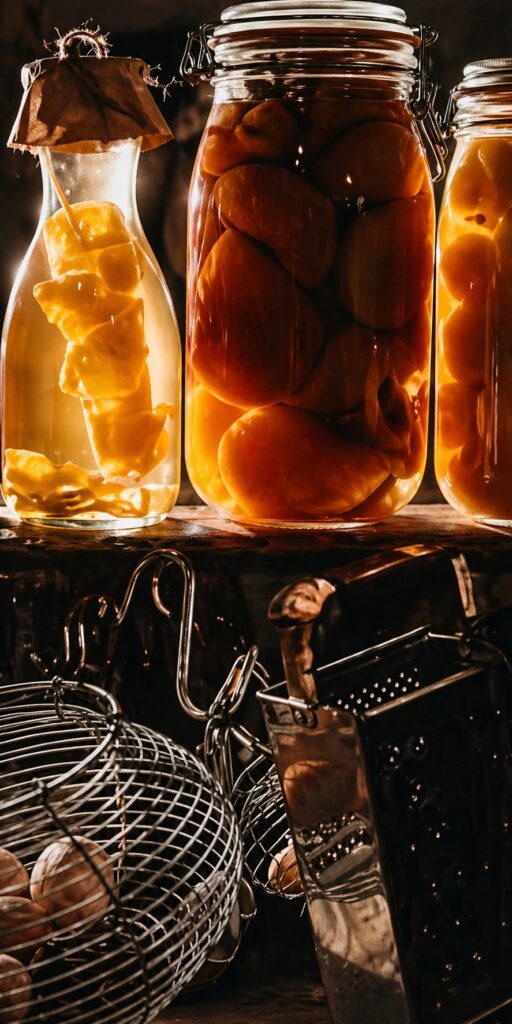
For European colonists abroad, food preservation was essential — it meant survival. Living in isolation, surrounded by different cultures, these colonists also discovered that preserving was a way of remembering home. Yet the food these settlers cooked was often adapted, a combination of local ingredients and traditional know-how. Recipes from this time make fascinating reading – specialties from all parts of the world are amalgamated with indigenous ingredients and techniques, creating unique and delicious dishes. This is particularly evident in North America: where else can one find pastrami and salt herring, ketchup and piccalilli living in harmony with salsa, jerky, and chili sauce?
With the advantage of hindsight, we can see how ancient techniques have evolved to suit our hectic lifestyle, and how the art of preserving has had a fundamental impact on our development and survival. Food preservation not only makes sense economically, utilizing gluts of fresh fruit and vegetables and prolonging shelf life, it also provides an opportunity to improve the flavor of bland ingredients and create a fond de cuisine of ready-made sauces, relishes, and ondiments upon which all creative cooking is based.
Safety Precautions For Preserving
- Care should be taken at all times when making preserves. Many factors affect the end result: correct hygiene, temperature control, timing, acidity, and sugar levels, storage conditions, and shelf life are all vital. Refrigeration or heat processing lengthens shelf life and discourages bacteria.
- Study the text on safety and hygiene, sealing and heat processing (see pages 42-45) and the relevant technique before starting a recipe.
- Follow the instructions given in each recipe and do not consume anything that seems questionable (see page 186).
- Extra care should always be taken with foods for vulnerable groups, including pregnant women, young children, and the elderly. Current health guidelines recommend that those in such groups do not consume unpasteurized foods, and therefore they should not eat home-preserved products.
Leave a Reply